On-Premise AI vs Cloud AI: How to Choose
Four questions settle most of the choice between running AI on your own hardware and renting it by the request. Score each one, then match your answers to a profile.
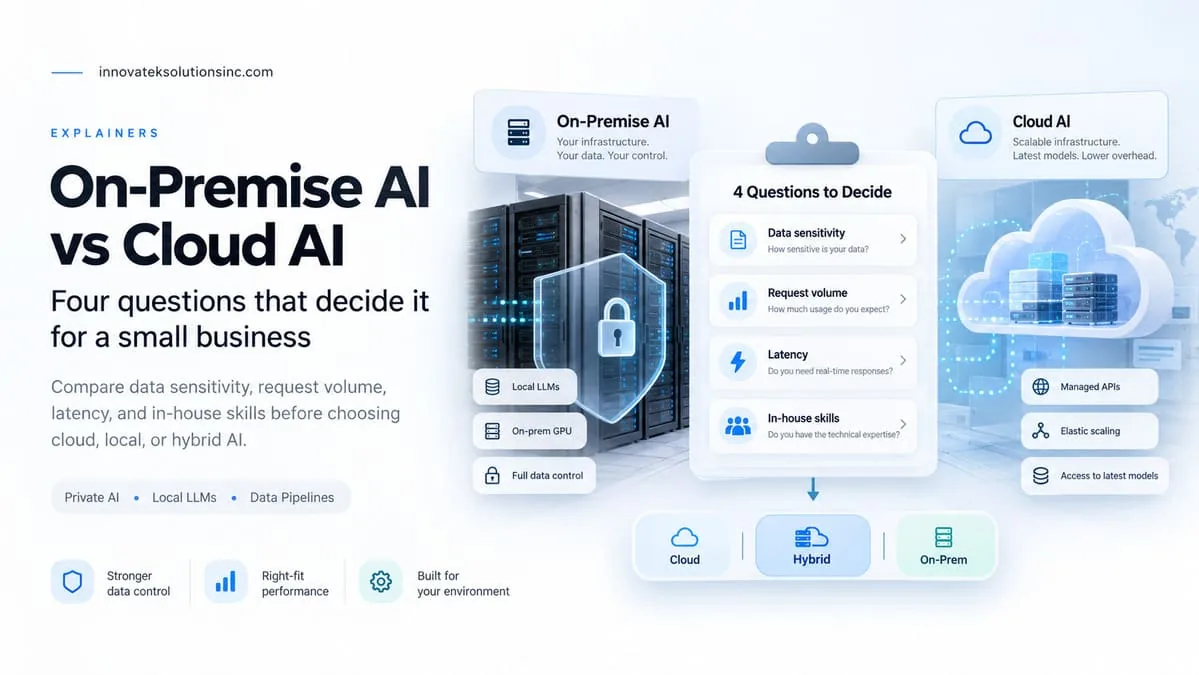
The on-premise AI vs cloud AI choice goes faster as four separate questions than as one argument about taste. How sensitive is the text or imagery going in? How many requests arrive, and how evenly? How quickly must an answer come back? And who in the building will keep a machine running?
"Cloud AI" here means sending a request to a model somebody else operates and paying per use or per seat. "On-premise AI" means an open-weight model running on hardware the company controls, so the prompt and the answer never cross the firewall.
Axis 1 - Data sensitivity
Start here, because this axis can end the discussion. Sort what the AI would read into three piles:
- Public or low-risk. Marketing copy, published product descriptions, general research questions. Nothing is lost if a third party sees it.
- Confidential by choice. Pricing models, source code, internal strategy, unreleased designs. Exposure hurts, but no outside rule forbids a vendor from processing it under contract.
- Confidential by obligation. Patient records, client files covered by professional secrecy, data a customer contract says may not leave a named location, government-controlled information. Here somebody else has already decided where the data may go.
For the first pile, the cloud is fine and the remaining three axes decide. For the third pile, the question becomes whether a cloud provider can meet the specific obligation in writing, and whether the company is willing to audit that. When the obligation names a site the company controls, or forbids any third party from handling the data, no vendor setting satisfies it.
The middle pile is where reading the terms pays off, because "not used for training" and "not stored" are separate promises, and a provider can make the first while still keeping logs for a while. The method for reading a provider's data-use terms is covered on its own. For this decision, the useful habit is to classify by the most sensitive thing a task will ever see, not the typical case. A drafting assistant that is fed a client letter once a week belongs in the third pile, even if most days it only polishes newsletters.
A practical test is to write the sentence "A copy of this text may sit on a vendor's servers for N days, readable by their authorized staff under these conditions." If the person accountable for the data can sign under that sentence, cloud is open. If not, the data stays inside.
Axis 2 - Request volume and its shape
Cloud AI is a variable cost: nothing used, nothing owed. A local server is a fixed cost that is paid whether it answers ten questions a day or ten thousand. So the thing to measure is how busy an owned machine would be.
Take a 20-person office where each person asks about 15 questions a day. That is 20 x 15 = 300 requests. Assume, purely for illustration, that each one keeps a GPU busy for 10 seconds. Busy time is 300 x 10 = 3,000 seconds. A working day of 8 hours has 8 x 3,600 = 28,800 seconds, so the machine is working 3,000 / 28,800 = about 10% of office hours and idle the rest, plus every night and weekend.
Low utilization does not make the purchase wrong. It means cost alone cannot carry the case, which has to rest on Axis 1 or Axis 3 instead.
Now change the workload. The same office also wants 200,000 archived documents classified and summarized. At the same illustrative 10 seconds each, that is 2,000,000 seconds, or 2,000,000 / 3,600 = about 556 hours of continuous work. A machine that would otherwise sit idle 90% of the time can do that across a few weeks of nights at no extra spend, while a per-token bill grows with every document. Steady, heavy, schedulable work is where owned hardware earns its place.
Shape matters as much as total:
- Thin and spiky (occasional questions) favors cloud.
- Steady and heavy (continuous extraction, classification, camera streams) favors local.
- Bursty beyond one machine (a monthly peak ten times the daily norm) favors cloud for the peak, because a provider's capacity stretches and a single server queues.
Turning volume into dollars is the job of finding the local versus API break-even, run with the company's own numbers.
Axis 3 - Latency and availability
Response time for a text model has three parts: network round trip, waiting for the model to start, and generating the output.
For a chat answer, generation dominates. A 300-token reply at an illustrative 40 tokens per second takes 300 / 40 = 7.5 seconds to finish. A network round trip to a cloud region is typically a small fraction of one second. Moving the model into the building saves that fraction and nothing else, so for ordinary chat and drafting, latency is not a reason to go local.
The picture changes when the output is short and the deadline is tight:
- Code autocomplete needs a suggestion before the developer types the next few characters. The budget is well under a second, and the network share of that is no longer small.
- Vision on a production line has to reject a part before it passes the ejector. Images are large and the line does not wait.
- Many small calls in a chain, such as classifying each of 50 fields in a form one at a time, pay the round trip 50 times.
Availability belongs here too. A cloud model depends on the internet link, the provider's uptime and the provider's model schedule. OpenAI's deprecations page, for example, says it regularly retires older models and that a model is no longer accessible after its shutdown date, so an application tuned for one version has to be re-tested on its replacement. A local model depends on one machine and whoever fixes it. Ask which outage the business tolerates better: "the internet is down, AI is down" or "the server is down until someone repairs it". A site with poor connectivity, such as a plant floor, a ship or a rural clinic, answers that quickly.
Axis 4 - In-house skills
A cloud API asks for a developer who can call an HTTP endpoint and someone to manage accounts and keys. That is the whole operational burden.
A local deployment adds real system administration:
- Installing and updating GPU drivers and the inference runtime without breaking the pairing between them.
- Choosing a model that fits the card's memory and testing it on the company's own tasks.
- Putting authentication in front of the model so it is not an open port on the office network.
- Watching it: memory, temperature, queue length, and whether it actually returns sensible answers.
- Re-testing and swapping models as better ones are released, with a way to roll back.
None of this is exotic for someone comfortable administering Linux servers. For an office whose IT is one generalist who also handles printers and phones, there are three honest options: train that person and accept a slower start, pay an outside party to install and maintain the system, or stay on cloud for anything the data rules allow. Pretending the server will run itself is the option that fails. Testing also takes skill: only a team that can score a local model on its own tasks will know whether the quality gap against frontier cloud models matters.
Recommendation by profile
Score each axis, then find the closest row.
| Profile | Sensitivity | Volume | Latency | Skills | Recommendation |
|---|---|---|---|---|---|
| Small office, general drafting and research | Low | Thin, spiky | Relaxed | Minimal | Cloud, on a business tier with terms that have been read |
| Professional firm with client files | Obligated | Moderate | Relaxed | Limited | On-premise for client material, installed and maintained with outside help |
| Software team protecting source code | Confidential by choice | Steady | Tight for autocomplete | Strong | On-premise; the team already has the skills and the latency need |
| Operations team with a large backlog to process | Mixed | Steady, heavy | Batch | Some | On-premise for the batch work, sized from a measured throughput test |
| Factory or site with weak connectivity | Mixed | Continuous | Tight | Some | On-premise or edge, since the link cannot be relied on |
| Company with both public and regulated work | Split | Mixed | Mixed | Some | Hybrid, routed by data class |
Two rules resolve most ties. First, sensitivity outranks the other three: if the data may not leave, volume and convenience do not reopen the question, they only decide how large a machine to buy. Second, when sensitivity is low and volume is thin, cloud wins even for a company that likes the idea of owning hardware, because an idle server is a cost with no matching benefit.
The last row is common. Few companies have only one kind of data, and splitting work between local and cloud models lets the regulated documents stay inside while low-risk drafting uses a hosted model.
A sensible next step, whichever row fits: pick the single task that would matter most, write down its four axis answers on one page, and have the person accountable for the data and the person who would run the system both sign it. Disagreement between those two signatures is the real decision to make.
Frequently asked questions
Does choosing an in-country cloud region satisfy a data location rule?
Sometimes, and the details decide it. OpenAI's data controls guide, read in October 2026, lists regions where both storage and inference stay in-region, and others where only storage does and content may be processed elsewhere. A rule about where data is processed needs the first kind, and a rule that forbids third parties is not met by any region.
Can a company start in the cloud and move on-premise later?
Yes, and it is a reasonable order when the data allows it. Common local runtimes such as Ollama and vLLM document OpenAI-compatible endpoints, so an application can often be repointed by changing an address and a model name. Prompts usually need re-testing, because a smaller local model responds differently to instructions written for a larger one.
How often should the decision be revisited?
Whenever one axis moves, rather than on a calendar. A new customer contract with a location clause, a backlog project that multiplies volume, or the departure of the one person who ran the server can each flip the answer. A yearly look at the one-page axis sheet catches the slower drift.
Which choice is better for image and video work?
Image and video workloads lean local more often than text does. Files are large, so uploading every frame is slow and bandwidth-hungry, the work is usually continuous, and footage of people or products tends to be sensitive. Occasional image questions, such as describing a handful of photos a week, fit a cloud model fine.
Ready to Modernize Your Business?
Get your AI automation roadmap in minutes, not months.
Analyze Your Workflows →