Private AI for Dental Practices
A local language model can draft procedure notes, claim narratives and patient letters from data the practice already holds. Reading X-rays is a cleared medical device category and stays out of scope.
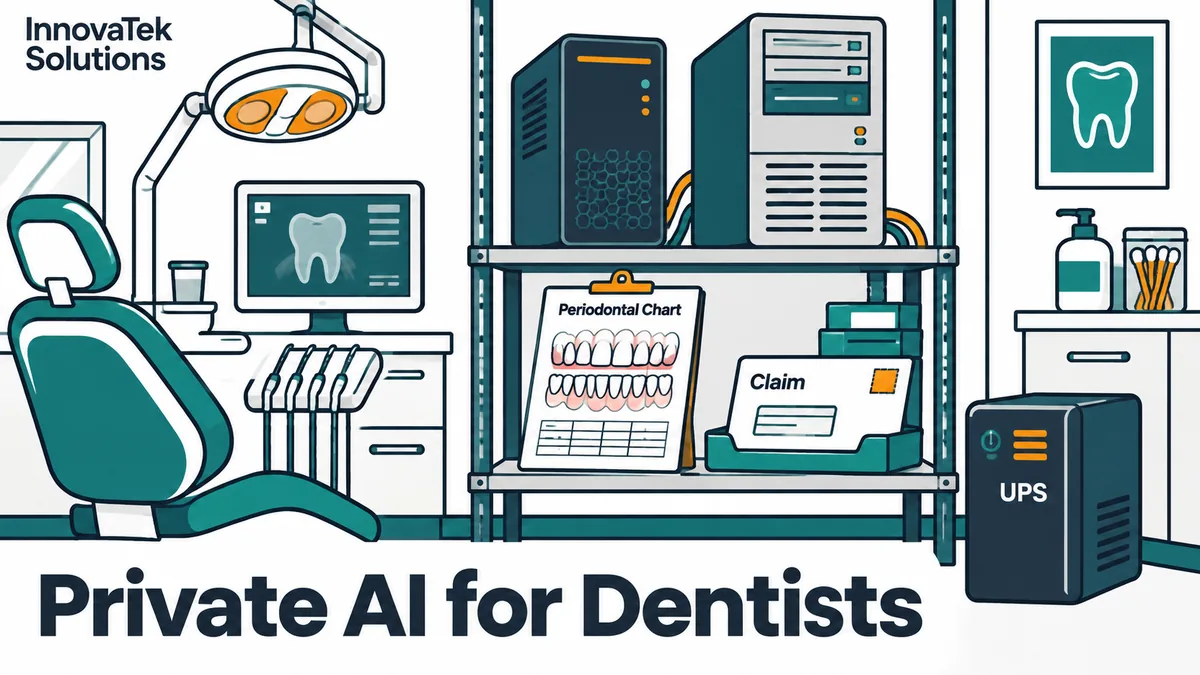
Take a practice with two dentists who each see 10 patients a day and three hygienists who each see 8. That is 2 x 10 + 3 x 8 = 44 clinical notes every working day, plus the claim narratives, treatment plan letters and post-op instructions that follow them. AI for a dental practice, run privately, means a language model on a machine in the office that drafts that text from what the chart and the clinician already say, so protected health information never leaves the building. Three jobs fit well: drafting the clinical note, assembling insurance narratives, and drafting patient communication. One job does not belong on the list: interpreting radiographs.
The HIPAA side, including what changes when no cloud vendor touches the data, is covered in what a BAA does and does not cover. This article covers what is specific to dentistry.
Radiograph reading is a regulated product, not a side project
Software that marks suspected caries on a bitewing is a medical device in the US. The FDA classification at 21 CFR 892.2070, "medical image analyzer", names radiograph dental caries detection among its examples, describes the device as a prescription aid that identifies and highlights regions of an image, and places it in Class II with special controls. Those controls include performance testing showing the device improves reader performance.
Commercial products already sit in that category. The FDA's 510(k) database lists Pearl's "Second Opinion" under product code MYN and regulation 892.2070, with a substantially equivalent decision dated March 4, 2022 (FDA record K210365).
Pointing a general vision model at the imaging folder and letting it flag decay would mean running an uncleared device. If radiograph detection is wanted, buy a cleared product. The in-house model follows the restate-only rule described for AI in a medical practice: no added finding, no tooth that was not mentioned, no image reading, and a named person signs every draft. The dental risk is subtle, because a vision-capable model will describe a bitewing if an imaging export lands in its input folder. Keep image files out of the AI box's reach entirely.
This is general information and not regulatory or legal advice.
Drafting the clinical note
A restorative note carries a tooth number, surfaces, the anesthetic type and amount, isolation, material and shade, and any post-op instructions given. A hygiene note carries the periodontal findings, home care discussed and the recall interval. The useful AI job is filling the free-text parts of the existing templates from a short dictation or terse shorthand.
A dictation such as "number 30 MOD composite, two carpules lido with epi, rubber dam, A2, patient tolerated well" becomes a full sentence in the practice's house format. The speech-to-text step runs on the same local hardware. Dental dictation is short and full of numbers and letters, so test the speech step on tooth numbers and surface strings before judging the language model.
The errors that matter in dentistry
Each pilot should compare drafts against the source line by line for these dental errors:
- Tooth numbers. In the US Universal system, 3 and 30 are a molar on opposite arches, and a single misheard digit moves the work to a different tooth. The draft should never contain a tooth number that is absent from the dictation.
- Surfaces. MOD and MO bill differently. Surface letters should be copied, never inferred.
- Quantities. Number of carpules, concentration of epinephrine, millimeters of probing depth.
- Perio numbers. Probing depths belong in the charting module, entered there by the hygienist or a voice charting tool built for it. The language model may refer to the chart ("see periodontal chart dated today") but should not retype six numbers per tooth into prose.
The same "not stated" rule used for medical visit notes applies here. In dentistry it matters most for the fields above, so the review step should check them first: a draft that names tooth 30 should be traceable to "30" in the dictation, and nothing else.
Insurance narratives
A narrative explains to a payer why a procedure was necessary. Payers publish what they expect, and the requirements are specific. Delta Dental's 2026 guidance on scaling and root planing, for example, asks for bitewing or periapical radiographs taken within 12 months that show bone levels, a visible loss of alveolar crest height of 2.0 mm or more measured to the cementoenamel junction, periodontal charting dated within the past 12 months, and possibly chart notes documenting stage, grade and need for treatment (Delta Dental provider notice). Another payer will differ, so keep one requirements file per payer and plan.
That structure suits a local model, because the narrative is assembly from facts already in the record:
- Code pulls the values. The integration reads the chart date, the deepest probing depths per quadrant, the radiograph date and the diagnosis from the practice management database and passes them to the model as labeled fields.
- The model writes the prose around them. It states the condition, the evidence and the treatment, using only the values it was handed.
- A checklist runs before the human sees it. If the chart is older than the payer's window or a required attachment is missing, the draft says so at the top instead of smoothing it over.
A short worked example of the time saved, with numbers to replace: if the office writes 6 narratives a day and each takes a staff member 8 minutes from scratch, that is 6 x 8 = 48 minutes. If reviewing a draft takes 3 minutes, the same work is 6 x 3 = 18 minutes, a saving of 30 minutes a day. Measure both figures before trusting either.
Procedure codes
The model should not be the source of truth for CDT codes. The ADA updates the code set every year; CDT 2027 brings 67 changes (28 additions, 33 revisions and 6 editorial updates) effective January 1, 2027 (ADA News), which is newer than any open model's training data. Validate every code in a draft against the current list held in the practice management system.
On licensing, the ADA states that dentists, dental teams and hospitals do not need a license to use CDT, and that buying the CDT manual covers using it in practice management software, while software vendors are commercial licensees. A practice loading code descriptors into its own internal tool is close to the first case, but a consultant packaging that tool for several practices may be closer to the second. Ask the ADA if in doubt.
Patient communication drafts
Dental offices send a lot of text that is personal but routine: a treatment plan explained in plain language, post-op instructions after an extraction, a note to a patient who has an unscheduled crown, a letter to a referring specialist. A local model can draft each from the chart and a template.
Two rules keep this safe:
- Money and dates come from the system, never the model. Fee estimates, insurance portions and appointment times should be inserted by code from the practice management data. A model asked to write "your estimated portion is" will produce a number, and it may be invented.
- Clinical content comes from the clinician. Post-op instructions should be the practice's approved text, with the model only adjusting tone or reading level. A model asked to explain why a crown is needed may add claims about outcomes that the dentist never made.
Every draft goes into a review queue, and a staff member sends it.
Small-office hardware realities
Most dental offices already run a server in a closet: the practice management database, imaging software, and backups, often on one machine. The temptation is to add the AI model to that box. Usually it is a bad idea, for three reasons.
First, the practice management database needs its resources during the day. Open Dental's programming notes warn that an unoptimized query can take 20 seconds and lock up every workstation in the office for that time. A GPU job competing for the same disk and CPU makes that worse.
Second, read access is the right shape for this work. Open Dental, which runs on MariaDB or MySQL, welcomes third-party queries as long as nothing writes to the database, and allows direct writes only through its API. Other systems have their own rules, so check with the vendor before connecting anything. A separate AI box with a read-only database account fits that model: it reads chart fields, drafts text, and hands the draft back for a human to paste or approve.
Third, the existing server rarely has room or power for a graphics card.
The load itself is light. If each of the 44 daily notes is about 400 tokens of output and the model generates 30 tokens per second for one request, the drafts take 44 x 400 / 30, about 587 seconds, or under 10 minutes of GPU time spread over a day. A single workstation-class machine with one current consumer GPU is usually enough for this volume. What matters more is where it sits: a closet that is already warm, a circuit shared with compressors or a sterilizer, and no UPS are the common failures. The details of case, power and noise are in building an AI server for a small office.
Start with insurance narratives. They use structured data the practice already holds, have a clear payer checklist to test against, and no patient ever sees a draft before staff do. Note drafting comes second, once the review habit is established.
Frequently asked questions
Can the AI box connect to the imaging software at all?
It can read file names, dates and image types to check that a required radiograph exists and is recent enough for a claim. That is bookkeeping. Opening the pixels and describing findings is the regulated part, and it should be left to a cleared product.
Does a voice-driven perio charting tool count as the same thing?
Voice charting that records the numbers a hygienist calls out is data entry, and it is sold as a feature of some practice management systems and as add-on tools. The language model described here works downstream of the chart, reading those numbers rather than capturing them, so the two do not need to be the same tool.
What happens if a payer rejects a narrative the model drafted?
Read the reason, fix the claim, and add the reason to that payer's requirements file, so the next draft's checklist catches it.
Is a small practice even a HIPAA covered entity?
A dental practice that conducts standard electronic transactions such as electronic claims is a covered entity, and most do. The requirements that follow, and how they apply to a local AI server, are on the HIPAA page. This is general information, not legal advice.
Ready to Modernize Your Business?
Get your AI automation roadmap in minutes, not months.
Analyze Your Workflows →