AI for Schools Without Exposing Student Data
FERPA, COPPA and state laws decide who may see student records and on what terms. A plain reading of the rules, what to demand from vendors, and how a district-run model handles staff drafting work.
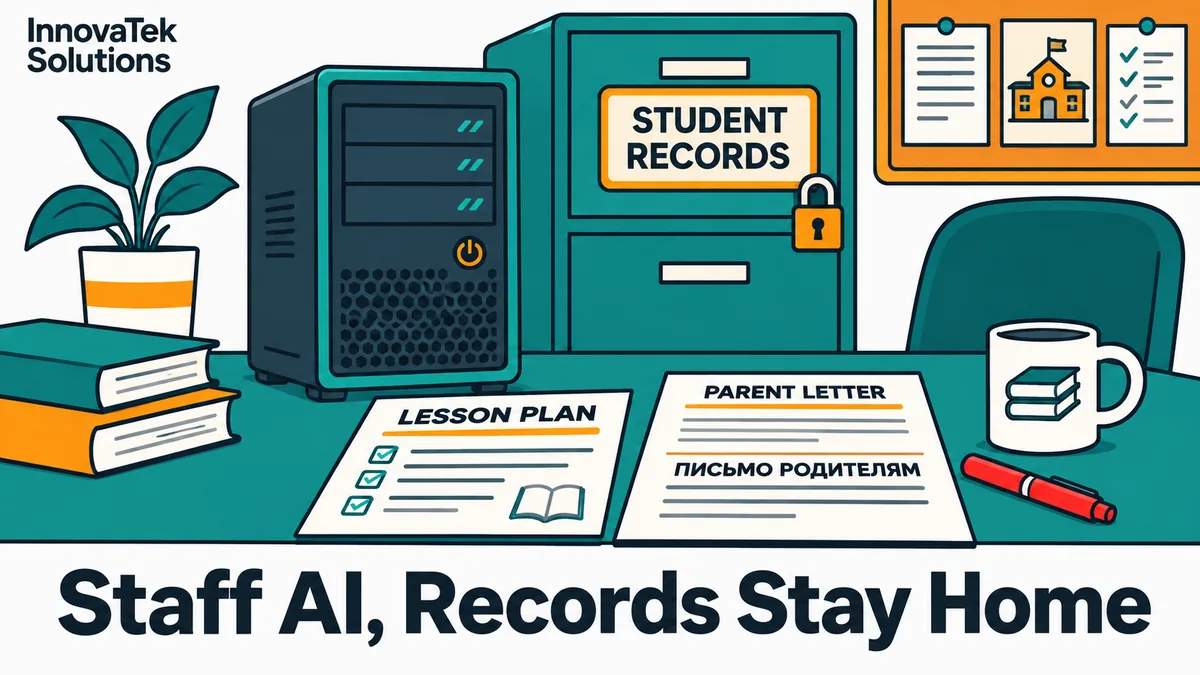
A seventh-grade teacher who pastes "Maria R., IEP for reading, missed 14 days this term, here is her essay" into a free chatbot has just moved an education record to a company the school has no agreement with. Under FERPA, that name, the disability service and the attendance count are all personally identifiable information from a student's record. The question behind AI for schools and student privacy is rarely whether staff should use these tools. It is which tool, under what contract, and which data is allowed to reach it.
This article summarizes the federal and state rules as of October 2026. It is general information, not legal advice, and a district's counsel should confirm how they apply locally.
What FERPA actually protects
FERPA's regulations define education records as records "directly related to a student" and "maintained by an educational agency or institution or by a party acting for the agency or institution" (34 CFR 99.3). Personally identifiable information is broader than a name. It includes parents' names, home address, student ID numbers, biometric records, indirect identifiers such as date of birth, and any other information that, alone or in combination, would let someone in the school community identify the student with reasonable certainty.
That last clause matters for AI prompts. "The only student in Room 12 with a cochlear implant" contains no name and still identifies a child.
The default is that a school needs written parental consent before disclosing PII from education records. The exception most AI tools rely on is the school official exception in 34 CFR 99.31(a)(1). An outside contractor can count as a school official only if it:
- Performs an institutional service or function for which the school would otherwise use employees.
- Is under the direct control of the school with respect to the use and maintenance of education records.
- Is subject to the redisclosure limits in 99.33(a).
The school's annual FERPA notice must also state the criteria for who counts as a school official and what counts as a legitimate educational interest (34 CFR 99.7). A consumer chatbot with click-through terms, which the district neither selected nor controls, does not meet the "direct control" condition. That is why staff use of personal AI accounts is a FERPA problem, and why the patterns described in what happens when staff paste data into chatbots apply to schools with extra force.
De-identified information is outside FERPA's consent requirement, but only after the school "reasonably determines" a student cannot be identified, taking other available information into account. Stripping the name from an essay that mentions a sibling, a team and a town does not meet that bar.
COPPA when students under 13 use a tool
COPPA governs operators of online services that collect personal information from children under 13. Its definition of personal information is wide: name, address, email, a persistent identifier such as an IP address or device ID, a photo, video or audio file containing a child's image or voice, geolocation and biometric identifiers (16 CFR 312.2). A student-facing AI tutor collects several of these within a minute of use.
FTC staff guidance says a school may act as the parent's agent and consent on the parent's behalf, but only where the operator collects the data "for the use and benefit of the school, and for no other commercial purpose." The operator must give the school full notice of its practices, and the school must be able to review the data, have it deleted and stop further collection (FTC COPPA FAQ). The FAQ states FTC staff views and does not bind the Commission.
The FTC amended the COPPA Rule in 2025. The changes took effect on 23 June 2025, with a general compliance date of 22 April 2026. The FTC had proposed writing the school authorization practice into the rule itself, but the final amendments left it out, so the school consent route still rests on staff guidance rather than rule text.
So if a vendor trains its general models on children's chats or uses them for advertising, the school's consent does not cover that use.
State student privacy laws
Many states have passed their own student privacy laws, and these often bind vendors more tightly than FERPA does. California's Student Online Personal Information Protection Act is a common template. It applies to operators of services designed and marketed for K-12 school purposes and bars them from knowingly using student data for targeted advertising, building profiles of students for non-school purposes, selling student information, or disclosing it outside listed exceptions. It also requires an operator to delete a pupil's covered information when the school or district asks (Cal. Bus. & Prof. Code 22584). The same section still lets an operator use student data to maintain, develop and improve its own service, so a training ban has to come from the contract, not the statute.
Two features of these laws catch districts out. First, the California definition only reaches services designed and marketed for K-12 school purposes, so a general-audience chatbot a teacher signs up for may fall outside it entirely. Second, some states require a written contract with set privacy terms before a vendor receives student data. Connecticut, for example, requires a board of education to sign a written contract containing listed provisions whenever it shares student records or student-generated content with a contractor, whatever the tool's terms of service say.
What a vendor agreement should say about AI
The Student Data Privacy Consortium publishes a National Data Privacy Agreement that many districts use as a starting point, with an exhibit that lets a vendor extend the same privacy terms to other districts that sign on. For an AI product, the generic template leaves gaps that are worth closing in writing:
| Clause | What to ask for |
|---|---|
| Training | Student data and staff prompts are not used to train or improve any model beyond the district's own instance |
| Subprocessors | A named list of model providers the vendor sends prompts to, with notice before changes |
| Retention | Prompt and output logs deleted on a fixed schedule, and on district request |
| Location | Where inference runs and where logs are stored |
| De-identification | No claim that data is "anonymized" unless the method is described |
| Breach | Notice period and who notifies families |
The subprocessor line matters most. Many education AI products are a front end on a large cloud model, so the district's data reaches a second company, which can be lawful only if the contracts chain correctly.
Where a district-run model fits
A model running on hardware the district owns avoids the subprocessor question entirely for one category of work: staff drafting. Nothing leaves the building, so there is no external party to bring under direct control. The district still controls access, logging and retention, as it does for its student information system.
Tasks that suit a local model well:
- Lesson and unit drafts. A teacher asks for a reading passage at a set level, discussion questions or a rubric. No student data is involved at all.
- Feedback drafts. The teacher pastes an essay with the name removed and asks for comments against the rubric, then edits them. The essay is still a student work product, which is why it should go to a district-controlled model and not a personal account.
- Parent letter translation. A general notice about a field trip or schedule change goes into several home languages. The local document translation article covers model choice and quality checks. Anything about an individual student, such as discipline or special education, needs a qualified human translator to review it before it is sent. What stays out: the student information system, IEP documents, health records, counseling notes and discipline files. The work above needs none of them, and keeping the model away from them is simpler than proving later that a chat log held no protected data.
A sizing example
Take a district with 400 teachers. Suppose a quarter of them use the tool on a busy afternoon, and each sends about one request every 10 minutes while working. That is 400 x 0.25 = 100 active users, sending 100 / 10 = 10 requests a minute. If a typical answer takes 20 seconds to generate, the server handles about 10 x 20 / 60 = 3.3 requests at any moment on average, with peaks higher. Whether one server copes depends on the model and the card, so measure a candidate machine under about that many parallel requests before buying, and plug in the district's own numbers.
A shared chat front end with district single sign-on gives staff a familiar interface and ties every conversation to an account. A guide to running Open WebUI for a team covers accounts, roles and document upload.
Rules that make the setup hold
- Sign-in with district accounts only. No anonymous access, and no student accounts on the staff instance.
- Chat history and server logs kept for a short, written period, then deleted automatically.
- A short staff rule, in the AI acceptable use policy, that names this tool as the approved one and lists the record types never to paste: IEPs, health information, discipline and anything from the student information system.
- The annual FERPA notice reviewed so its school official criteria match how AI tools are actually used.
A sensible first step is a one-semester pilot on lesson drafts and parent letter translation, adding feedback on student work later.
Frequently asked questions
Is a teacher's own grading comment an education record?
It depends on where it lives. A private note kept in the teacher's sole possession and used only as a memory aid is excluded from the definition of education records. Once a comment is shared with the student, entered in the gradebook or stored in a district system, it is part of the record and FERPA applies.
Can students use the same local model as staff?
Technically yes, but student accounts bring COPPA into play for children under 13, need age-appropriate content filtering and create logs of children's own writing. A separate instance with its own rules and retention keeps the two sets of obligations apart.
Does running the model locally make a district compliant automatically?
No. It removes the vendor and its subprocessors from the picture, which is the hardest part of most AI contracts. Access control, logging, retention, staff training and the annual notice are still the district's job, as they are for every other system holding student information.
Do these laws apply to private schools?
FERPA applies to schools that receive funds from programs administered by the US Department of Education, which excludes many private K-12 schools. COPPA applies to the operator of the online service whatever kind of school uses it, and state laws vary in whether they cover private schools.
Ready to Modernize Your Business?
Get your AI automation roadmap in minutes, not months.
Analyze Your Workflows →