What the Span × NVIDIA Deal Means for SMB Operators
AI infrastructure is about to move three SMB line items: electricity, leases, and AI tooling. A 12-month operator checklist for service businesses.
When Your Electricity Bill Becomes an AI Story: What SMB Operators Should Watch After the Span × NVIDIA Announcement
Last month, Span (a smart-electrical-panel manufacturer) and NVIDIA announced a partnership that, on the surface, looked like a residential-energy story.
It's not.
The two companies, along with homebuilder PulteGroup, are deploying XFRA - a distributed network of compute nodes installed inside customer homes, running AI workloads for hyperscale tech companies. Each node carries enterprise-grade GPUs and CPUs. The host homeowner gets free or discounted electricity. The hyperscaler skips the seven-year wait to connect a new data center to the grid.
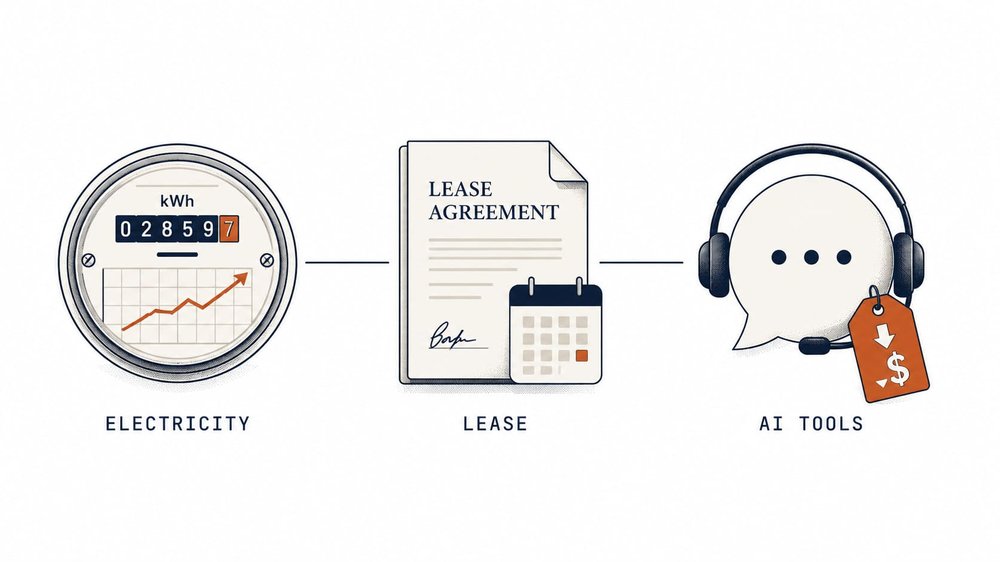
For SMB operators, this is worth paying attention to - not because it changes anything this quarter, but because it signals where three of your line items are headed over the next 24-36 months:
- Commercial electricity rates
- Commercial lease economics
- The price of AI tools you might actually use
Here's how to think about each one.
Why This Matters for SMB Operations
The headline numbers from the announcement:
- Speed-to-power for new data centers: up to 7 years (Center for Strategic and International Studies)
- Span's target capacity: 1 GW deployed annually starting 2027
- Equivalent capex: ~$50B per GW (NVIDIA estimate)
- Per-home compute value: ~$1M, distributed across roughly 50,000 hosts
In plain language: hyperscalers can't build central data centers fast enough to meet AI demand. They're now actively pursuing distributed alternatives. Span × NVIDIA is one model. There will be others.
This affects SMBs through three indirect mechanisms.
Mechanism 1: Commercial Electricity Rates Will Move
Residential and commercial electricity are priced differently, but they share infrastructure. When demand grows faster than utility capacity, the political reality is consistent: residential rates are protected first, commercial rates absorb the increases.
Two scenarios are possible:
Optimistic scenario. Span's grid-utilization argument plays out. Adding compute load to underutilized residential infrastructure spreads the utility's fixed costs over more kWh sold, putting downward pressure on rates across all customer classes. SMBs benefit indirectly.
Pessimistic scenario. Distributed AI compute scales faster than the grid expands. Combined with building electrification, EV charging, and industrial reshoring, the "spare capacity" thesis breaks down. Utilities hit capacity constraints. Commercial rates rise to fund grid expansion.
Which one happens depends on factors outside any SMB's control. What's inside your control is how you contract.
What to do this quarter
- Audit your existing commercial electricity contracts. Identify rate-escalator clauses, capacity surcharges, and any pass-through language tied to "infrastructure upgrades" or "grid investment recovery."
- For contracts up for renewal in the next 24 months: push back on open-ended pass-throughs. Negotiate caps on annual increases. If your provider can't or won't accommodate, get quotes from competitors before signing.
- For multi-location operators: track rate trajectories by state. States hosting early XFRA deployments (Nevada, Arizona, possibly Texas) are leading indicators for what other markets will see in 18-24 months.
Mechanism 2: Commercial Leases Are About to Get Renegotiated
Most commercial leases written before 2024 didn't anticipate AI infrastructure as a major utility cost driver. The common area maintenance (CAM) language, the utility pass-through clauses, and the "tenant improvements" sections were written for a world where data-center load wasn't a national-grid story.
That world is over. The renewal cycle is where it gets corrected - usually in the landlord's favor unless tenants push back.
What to do this quarter
- Pull your active leases and identify renewal dates. Anything renewing in 2026-2027 is in the window where AI-infrastructure cost pressure will be visible to landlords but not yet priced in.
- Three clauses to scrutinize on renewal:
- Utility cost pass-throughs (capped vs. uncapped)
- CAM increase formulas (fixed % vs. actual cost recovery)
- Future capital improvements (who pays for HVAC upgrades, electrical service upgrades, EV charging infrastructure, rooftop solar adds)
- For multi-location operators: consider front-loading renewals where you have leverage. A 5-year renewal signed in 2026 with capped escalators is materially different from the same renewal signed in 2028 after the market has repriced.
Mechanism 3: AI Tools Are About to Get Cheaper
This is the upside side of the story, and it's where most SMB operators are under-prepared.
The whole reason hyperscalers are pushing distributed compute is that AI workloads are about to be everywhere - and they need to drive the cost of inference (running AI models in production) down dramatically to make the unit economics work.
The downstream effect on SMBs is real: voice agents, scheduling systems, customer-reactivation automation, review management, predictive demand forecasting, and a dozen other categories of AI-powered operational tools will become 30-60% cheaper between now and 2027.
If your team has previously evaluated AI tools and walked away because the math didn't work, those decisions need to be revisited on a 6-month cadence, not a 2-year cadence. The pricing is moving that fast.
What to do this quarter
- Maintain a "deferred AI tools" list. Every tool you evaluated and rejected on price in the last 18 months - note the vendor, the use case, the rejection reason, and the price quoted.
- Revisit quarterly. Vendors will quietly drop prices as their underlying compute costs fall. The first quote isn't the best quote anymore.
- Prioritize tools that recover lost revenue over tools that save labor cost. A voice agent that captures one additional booking per day at a $150 service business is worth more than an AI scheduling tool that saves 30 minutes of front-desk time. Recovered revenue scales; saved labor usually doesn't get reinvested.
The Operational Risk Most SMBs Are Missing
There's a fourth mechanism that doesn't get enough attention: competitive AI adoption is accelerating.
The same lower-cost AI infrastructure that benefits your business is also available to your competitors. SMBs that adopt AI-powered customer-facing tools in the next 18 months - voice agents, after-hours booking, automated review management, predictive customer outreach - are going to capture market share from SMBs that don't.
This isn't a tech story. It's a market-share story.
The salon that picks up after-hours calls captures bookings the salon down the street misses. The plumber whose voice agent quotes basic jobs at 11 PM books the emergency call that the plumber with voicemail loses. The dental office that texts appointment reminders with AI-powered cadence reduces no-shows that the office still calling by hand absorbs.
The XFRA announcement is one piece of a larger trend that ends with AI-powered operational tools becoming table stakes for service SMBs. The window where adopting them is a competitive advantage is closing. The window where not adopting them becomes a competitive disadvantage is opening.
What This Looks Like as an Operating Plan
Pulling it together into a 12-month checklist:
Within 30 days
- Audit commercial electricity contracts for rate-escalator and capacity-charge clauses
- Pull all active leases and identify renewal dates within the next 24 months
- Build the "deferred AI tools" list
Within 90 days
- Get competing quotes on any electricity contract with open-ended pass-through clauses
- Identify the top 3 AI-powered operational tools you'd adopt if pricing improved by 30%
- Run a single pilot on the highest-value AI tool from that list
Within 12 months
- Renegotiate leases with renewals in window - push back on uncapped utility pass-throughs and CAM formulas
- Operationalize 1-2 AI tools that produced measurable ROI in pilot
- Establish a quarterly review cadence on the "deferred AI tools" list
The Bottom Line
The Span × NVIDIA announcement isn't directly about SMBs. But it's a credible signal that AI infrastructure is going to grow in ways that affect three SMB cost lines - electricity, real estate, and AI tooling - across the next 24-36 months.
The operators who notice early and adjust their contracts, leases, and tooling evaluations will be in materially better shape in 2028 than the operators who don't.
That's the entire story. The technology is interesting. The operational implications are the part that matters.
InnovaTek works with service SMBs and franchise operators on the operational side of AI adoption - from tool evaluation to pilot design to integration with existing systems. If you're trying to figure out which of these categories is worth attention this quarter, talk to us.
Ready to Modernize Your Business?
Get your AI automation roadmap in minutes, not months.
Analyze Your Workflows →