Weekly Threat Roundup: AI Jailbreak Gaps, Ransomware Demands and a Wave of Impersonation Scams
Attackers keep leaning on things people already trust - a job offer, a service outage notice, a familiar app - to steal data and slip past defenses. This week's stories show both new tricks and...
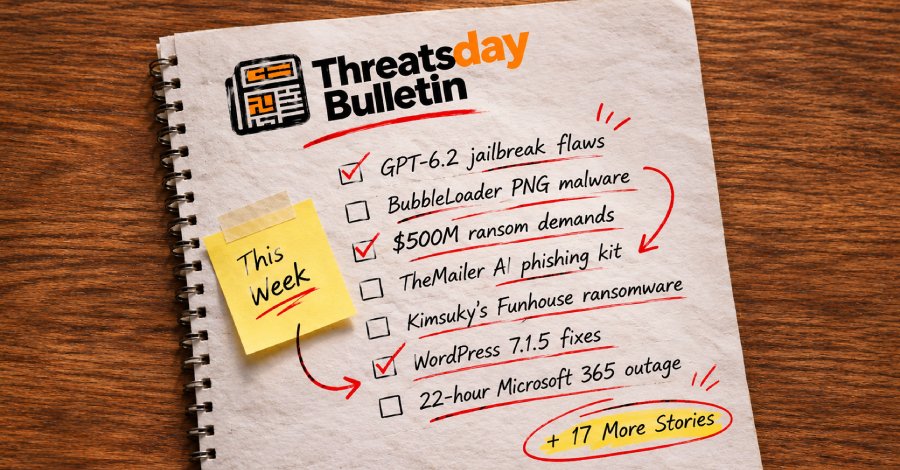
Attackers keep leaning on things people already trust - a job offer, a service outage notice, a familiar app - to steal data and slip past defenses. This week's stories show both new tricks and old problems that never went away.
Google says its latest Gemini model produces more secure code than its predecessor and performs well on vulnerability-finding benchmarks, and it is being rolled out to trusted defenders. OpenAI, meanwhile, says its newest GPT-6.2 models mark a significant jump in cyber capability, even as the U.K. AI Security Institute reported it developed a universal jailbreak against pre-release versions in roughly half the queries needed for the earlier model - a regression OpenAI says it has since fixed.
WordPress shipped a security release and urged site owners to update immediately, with patches backported to older branches. Separately, OpenAI said independent evaluators from Apollo Research, Goodfire, METR and Transluce will be embedded in its organization as part of a safety pilot.
In law enforcement, a Kazakh national was extradited from Italy to face U.S. charges over an extortion campaign against schools and hospitals that the FBI says generated more than $500 million in ransom demands. Ukrainian authorities and the FBI arrested four suspected members of an international ransomware group linked to over $40.5 million in payments from at least 28 companies.
Reuters reported that Chinese entities are using distillation techniques against American AI models to train domestic rivals. Researchers also flagged a criminal marketplace selling infostealer data with AI-written profiles of victims' machines, and a North Korean group distributing Funhouse ransomware through a malicious Hangul document disguised as a resume.
Other items: Ireland's regulator plans an €11 million fine against Match Group over Tinder's data-download tool; Broadcom found one-letter lookalike domains registered within a day of real brand domains; the EU sanctioned Moscow's Social Design Agency and 24 individuals; a GravityRAT campaign used a fake recruitment portal to target defense job seekers in India; Infoblox disclosed a third-party breach exposing customer and staff data; Microsoft tracked phishing that exploited a 22-hour M365 outage; researchers detailed the AI-driven TheMailer phishing kit; Bulgaria uncovered a five-year government hacking operation; and ReversingLabs described BubbleLoader, a loader that hides payloads in PNG files attached to legitimate software.
The methods keep shifting, but the lesson doesn't: watch the ordinary things.
Source: The Hackers News
Ready to Modernize Your Business?
Get your AI automation roadmap in minutes, not months.
Analyze Your Workflows →