Researcher Reports Database Exploit Chains Against PostgreSQL, MySQL, Oracle and ClickHouse; None Seen in Real Attacks
A researcher has published proof-of-concept exploits showing that low-privilege database accounts - ones that cannot read a single application table - can still be used to run code on the database...
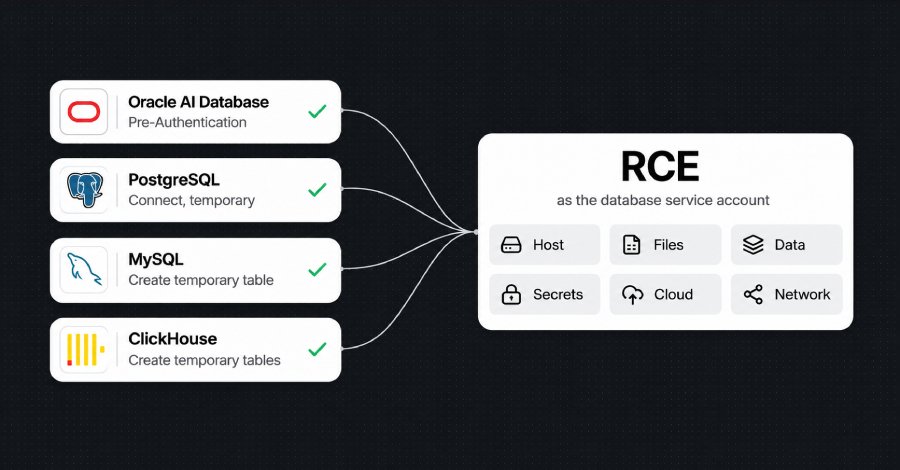
A researcher has published proof-of-concept exploits showing that low-privilege database accounts - ones that cannot read a single application table - can still be used to run code on the database server itself, by reaching memory-corruption bugs in the engine code that sits behind ordinary SQL. The work targets PostgreSQL, MySQL, ClickHouse and Oracle. The full attack chains have not been independently reproduced, and the research reports no sign that any of them has been used in a real attack.
The research is by Zheng Yu of Depthfirst. The argument is that an account's SQL permissions govern which tables and schemas it can touch, not the memory-unsafe C and C++ code the engine runs to read, plan and execute a query. Common grants leave enough room to reach that code: PostgreSQL's default TEMPORARY privilege, or the right to create temporary tables in MySQL and ClickHouse, lets an account create objects or send input that triggers a memory bug.
For PostgreSQL, the researcher describes a flaw that lets an account able to create database objects run code as the operating system user running the database, built entirely in its own temporary schema without touching application data. A fix was issued in a security advisory, and the CVE record credits the researcher for the report. MySQL has a comparable flaw in its query optimizer, which Oracle's advisory rates as requiring high privileges - a rating narrower than what the researcher says was needed to reach code execution with an account limited to creating temporary tables.
Oracle Database is the case where, according to the researcher, no account is needed at all: a bug in Oracle Text and a flaw in the GraphQL interface of Oracle REST Data Services, chained against an exposed web endpoint, reach the engine code and run commands before any login. Oracle patched both, in its November and October updates respectively, and rates neither as exploitable without a login on its own.
ClickHouse is the fourth target, with the researcher reporting an integer-overflow write in how it reads a binary row format, reached by setting a single option to zero, and reproducing a shell on a tested version. That one has no CVE and no confirmed fixed version, so operators should check with the vendor.
Beyond installing updates, the researcher's advice is to review what accounts can do, not only what they can read, and to strip the TEMPORARY privilege and broad temporary-table rights from accounts that do not need them. That step does not close the Oracle path, which starts without any account.
Source: The Hackers News
Ready to Modernize Your Business?
Get your AI automation roadmap in minutes, not months.
Analyze Your Workflows →