At the UN AI Summit, Robot Dogs and Hard Questions About What 'Good' Really Means
The AI for Good Summit, hosted by the UN's International Telecommunication Union in Geneva, was a sensory overload. Attendees dodged live coding sessions, navigated obstacle courses of gadgets,...
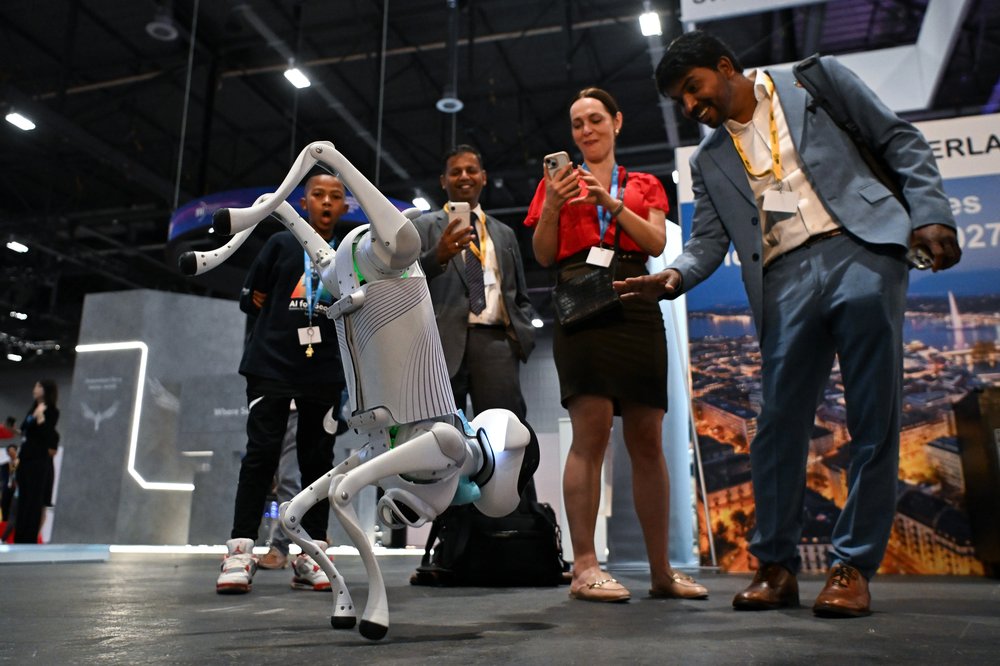
The AI for Good Summit, hosted by the UN's International Telecommunication Union in Geneva, was a sensory overload. Attendees dodged live coding sessions, navigated obstacle courses of gadgets, and saw people wandering around with glowing green headphones broadcasting panel discussions. In the Networking Zone, a rotating bench called UFOTECH spun participants like a lazy Susan, making genuine conversation a dizzying challenge. Amid the chaos, the question that hung over the 106,000-square-meter convention center was deceptively simple: What does AI for good actually look like?
The summit's idealism clashed with real-world skepticism. Doreen Bogdan-Martin, the ITU's secretary-general, declared that responsible AI could help solve hunger, disease, and climate change. But on the sidelines, Giulio Coppi of Access Now warned that the "age of innocence" is over, calling out the humanitarian sector's overreliance on big tech. Harvard professor Vijay Janapa Reddi cut through the hype, noting that "good" is too vague for engineers to build toward. Meanwhile, pro-Palestine activists stormed a keynote by Amazon's CTO, alleging the company's tech is being used in conflict zones. The tension between lofty promises and on-the-ground realities was impossible to ignore.
Beyond the spectacle - Tesla Cybertrucks parked next to UN rescue helicopters, humanoid robots sprinting past baffled attendees - the summit grappled with infrastructure and access. Speakers argued that compute power is a development issue, not just a technical one. Syed Munir Khasru of the Institute for Policy, Advocacy, and Governance insisted that "compute for all" requires treating AI as development infrastructure. Others pointed out that most large language models are English-centric, leaving poorer communities underserved. The politics of who controls the chips and standards ran through every session, and while the UN announced a 44-member commission co-chaired by Rwanda's president and Salesforce's CEO, the tech on the floor was already racing ahead of any consensus.
Source: Wired
Ready to Modernize Your Business?
Get your AI automation roadmap in minutes, not months.
Analyze Your Workflows →