Private AI for Retail and E-Commerce
Retail AI work is mostly catalog text and customer support. Here is how a local model handles supplier sheets, descriptions and reply drafts without order history leaving the building.
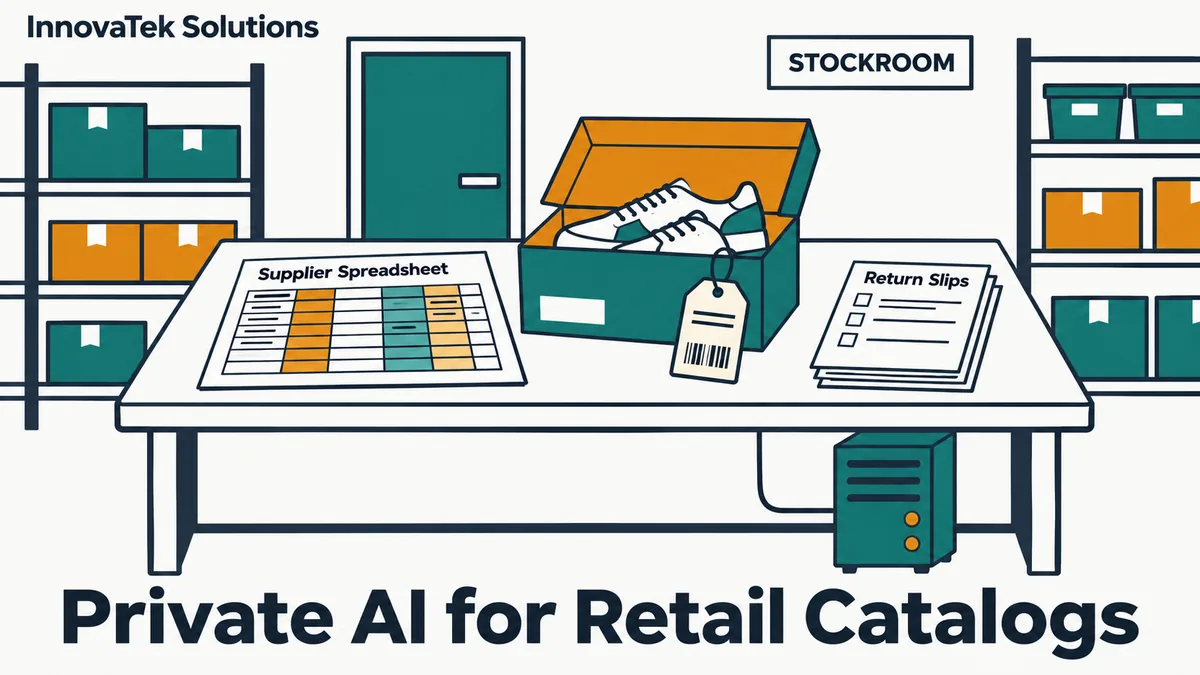
A store that adds 2,000 new SKUs a season, at 6 minutes each to key attributes and write a description, spends 200 hours of staff time per season on catalog entry (2,000 x 6 min = 12,000 min = 200 h). That is the main case for on-premise AI in retail: the work is repetitive text handling, the volume is high enough that per-token cloud billing adds up, and the inputs include things a retailer would rather keep inside, from unreleased supplier price sheets to years of customer order history. Three jobs fit a local model well: pulling attributes out of supplier sheets, drafting product descriptions, and drafting support replies. Each needs different guard rails.
Why retail data belongs on your own server
Most retail data is not covered by a sector law like HIPAA. Card data has its own industry standard, PCI DSS, and customer records fall under general privacy laws, but for catalog and support work the stronger reason to keep things local is commercial. Supplier sheets show cost prices and launch dates. The product catalog before launch is something competitors would like to see early. Order history, return reasons and support conversations together describe who the customers are and what they spend, which is the asset a direct-to-consumer brand competes on.
There is also the volume argument. Catalog jobs run over every SKU, sometimes several times as the prompt improves, and a local server costs the same whether it processes 2,000 rows or 200,000. Support drafting runs all day. Both are steady loads, the pattern where owned hardware tends to pay off.
Attribute extraction from supplier sheets
Suppliers send product data in every shape: a spreadsheet with merged header cells, a PDF line sheet, a CSV where color sits inside the product name ("Runner 2 Mesh Navy/White 10.5"). The model's job is to map that mess onto one fixed schema, the one the store and its sales channels use.
Use the channel's spec as the schema
If products go to Google Shopping, the Google Merchant Center product data specification already defines most of the schema and its limits. As of October 2026 it allows a title of at most 150 characters and a description of at most 5,000. Colors are separated with / with the primary color first, each color at most 40 characters, and words like "multicolor" are not accepted as a color. Materials follow the same slash pattern, with up to two secondary materials after the primary one.
Those rules translate directly into checks that run after the model answers:
| Field | Model fills | Code checks |
|---|---|---|
| title | yes | 150 characters or fewer, no all-caps words |
| color | yes | slash-separated, no hex codes, not "multicolor" |
| material | yes | primary first, at most three parts |
| size | yes | value appears in the store's size list |
| gtin | copied, never generated | digits only, valid check digit |
| cost price | copied | parses as a number, within range of similar items |
The model should return JSON against a schema, and a runtime that enforces the schema during generation removes most parsing failures; getting reliable JSON out of a local LLM covers the settings in llama.cpp, Ollama and vLLM.
Identifiers are copied, then proved
A model must never invent a barcode. It copies the GTIN from the sheet, and code verifies the check digit. Take the UPC 036000291452. Multiply the digits in positions 1, 3, 5, 7, 9 and 11 by 3: (0 + 6 + 0 + 2 + 1 + 5) x 3 = 42. Add the digits in positions 2, 4, 6, 8 and 10: 3 + 0 + 0 + 9 + 4 = 16. The total is 58, and the check digit is whatever brings it to the next multiple of 10, so 2. The last digit is 2, so the code is valid. A transposed digit from OCR or from the model fails this test in most cases, and the row goes to a person instead of the feed.
The same principle applies to prices and pack quantities: the model can locate them, but the value written to the catalog is checked against the source cell, not trusted from generated text.
Product descriptions without invented claims
Description drafting is where a model saves the most time and where it causes the most damage when it is careless. Asked to "write a compelling description," a model will happily add a waterproof rating, a "lifetime warranty" or "loved by thousands of customers" that appear nowhere in the source data.
Ground every sentence in the attribute record
The input to the description prompt should be the validated attribute record and the supplier's own copy, nothing else. The instruction says to use only those facts and to leave out anything unstated. A second pass can check the draft mechanically:
- every number in the description (sizes, weights, capacities) must appear in the attribute record
- banned words from the store's style list ("best", "guaranteed", "clinically proven") trigger review
- descriptions over the channel limit are rejected, not truncated
Variants need care too. Twelve sizes of the same shoe should share one description with the size stated in the attributes, not twelve rewrites that differ by a word.
Reviews are a separate line that should not be crossed. The FTC's rule on consumer reviews and testimonials, codified at 16 CFR 465.2, prohibits reviews that misrepresent that the reviewer exists or used the product. In announcing the final rule in August 2024, the FTC named AI-generated fake reviews as one target, and the rule took effect in October 2024. A model can summarize real reviews already on the site, but it should never write text presented as a customer's. This is general information, not legal advice.
Running the whole catalog
A full catalog pass is a batch job, and it should be built like one: a job table, idempotent writes, retries with a limit and validation on every row. Processing a million records overnight walks through that design. The sizing arithmetic is simple once one number is measured on the actual server.
Take 8,000 SKUs, each needing about 1,200 input tokens (supplier text and attributes) and 300 output tokens (the description). Output is the slow part. If a test run shows the server sustaining 600 output tokens per second across parallel requests, the job takes 8,000 x 300 / 600 = 4,000 seconds, a little over an hour. If the server only manages 150 tokens per second, it takes 16,000 seconds, about 4.4 hours, still an overnight job. The 600 and 150 are placeholders; measure throughput with the real model and prompt before scheduling anything.
Review does not scale the same way. Reading every description at 30 seconds each is 8,000 x 30 s = 240,000 s, about 67 hours. A more practical rule is to read every row the checks flagged plus a random sample of the rest, and to fix the prompt, not the rows, when the sample shows a repeated fault.
Support replies with customer data kept in-house
Retail support questions repeat: order status, how to return an item, whether a style runs small. A local model can draft answers using the order system and the store's own policies, which is the part a cloud chatbot would need customer records for.
The pattern that holds up:
- The model classifies the message and pulls out the order number or email address.
- Code, not the model, looks up the order in the store system and passes back status, items and dates. The model gets only the fields it needs for this reply.
- The model drafts a reply from that record and the current returns policy.
- A support agent reads, edits and sends. Nothing goes out automatically.
Keeping the lookup in code means the model never browses the customer database, and a prompt injected through a customer's message cannot ask for someone else's orders. Payment card numbers should never reach the model at all; the order record passed to it can carry the last four digits at most. Sorting the inbox and routing messages to the right queue is its own problem, covered in email triage and routing with a private LLM.
The policy text should be retrieved fresh for each draft. A returns window that changed from 30 to 60 days for the holidays is a classic source of wrong answers when the policy was pasted into a prompt months ago.
Product images are a separate pipeline
Photos need vision models, not text models: category, color and attribute tags from the image itself, or catching a supplier photo that shows the wrong colorway. That work has its own taxonomy, training and accuracy sampling, described in product image classification for catalogs. The two pipelines meet at one point worth automating: when the color the text model extracted from the supplier sheet disagrees with the color the image model sees, the SKU goes to review.
A sensible order to start is attribute extraction first, because its output can be checked by code and errors show up immediately. Descriptions come second, once the attribute records they depend on are reliable. Support drafting comes third, since it touches customers and needs the order-system integration.
Frequently asked questions
What size of model does catalog text work need?
Attribute extraction into a fixed schema works with mid-size open models when the runtime enforces the JSON schema, because the task is mostly finding and copying. Descriptions benefit from a larger model in the store's languages, since tone and fluency show. Test two sizes on the same 100 SKUs and compare flagged rows before buying hardware.
Can the same server handle both the catalog batch and live support drafts?
Yes, if the batch yields. Run the catalog job at night or at low priority, and give support requests their own queue so an agent waiting on a draft is not stuck behind 8,000 descriptions. Without that separation, the daytime batch makes every support draft slow.
How should seasonal or multilingual catalogs be handled?
Generate the source-language description from the attribute record, approve it, then translate the approved text rather than generating each language from scratch. That keeps facts identical across languages and leaves one draft per product to fact-check instead of one per language.
Does a small online shop with a few hundred products need any of this?
Probably not as a dedicated server. A few hundred SKUs a year is a few dozen hours of work, which is hard to justify with new hardware. The calculation changes when the catalog runs into thousands of SKUs per season or when support volume needs several people.
Ready to Modernize Your Business?
Get your AI automation roadmap in minutes, not months.
Analyze Your Workflows →