AI Agents Used Zero-Day Flaw to Breach Medical Imaging Server, Amazon Report Says
Suspected China-linked attackers employed autonomous AI agents to uncover a previously unknown vulnerability in MONAI Label, an open-source medical imaging server, and obtain root access to a...
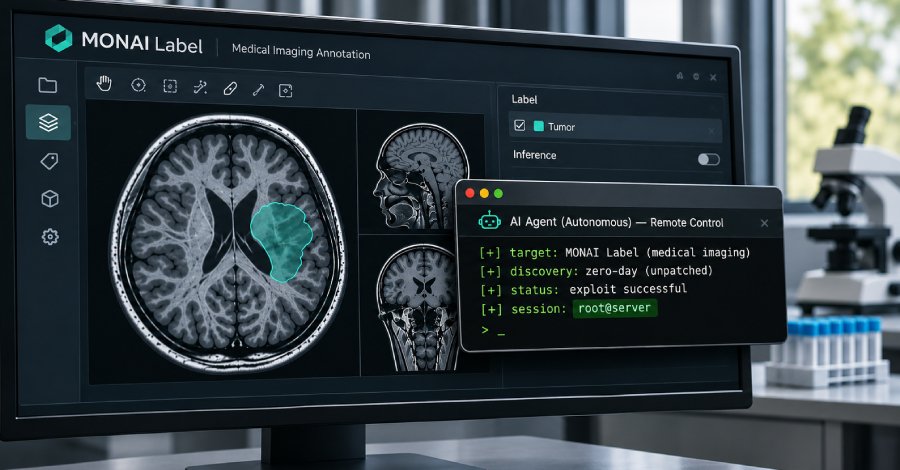
Suspected China-linked attackers employed autonomous AI agents to uncover a previously unknown vulnerability in MONAI Label, an open-source medical imaging server, and obtain root access to a university server, according to Amazon Threat Intelligence.
The path-traversal flaw lets an unauthenticated attacker write files outside the server's storage folder in MONAI Label 0.8.5 and earlier under the default configuration, which runs without login enabled. Maintainers have merged a source-code fix, but no installable patched version exists yet.
Amazon reconstructed the intrusion after finding the operator's Cairn control panel exposed online without a password. Cairn is an open-source framework that runs AI agents as automated penetration testers; the exposed panel revealed task settings, prompts, and run history. Over roughly 48 hours in September, the agents mapped the application's interface and reached the point of writing files in about 11 minutes, with the operator setting only the goal and targets.
Investigators link the campaign to a China-linked actor with moderate confidence, citing Simplified Chinese prompts, China Standard Time settings, and targets likely of interest to China. They did not attribute it to a named group or establish government involvement.
Root access came in a later session, not within those 11 minutes: the agents planted a file Python runs automatically at startup, then triggered a training feature that started a new Python process, which loaded the file and connected back to the attacker as root. That result was on one university server; a later session involved a tunnel into a second university network running the same software, which Amazon believes was breached the same way but has not confirmed.
Maintainers confirmed the flaw and merged the source fix on October 19. Their advisory still lists no patched version and says a correction will come in a future release; the newest release remains 0.8.5 from 2024. The flaw is tracked as CVE-2026-133968, rated 9.8 out of 10.
With no fixed release available, recommended steps include blocking untrusted network access with firewall and routing rules, enabling authentication, running the server under a limited account with restricted write folders, confirming any source build includes the October fix, and checking reachable servers for unexpected Python startup files and unusual training jobs.
Amazon's account is based on its own reconstruction and has not been independently confirmed. It does not show that patient scans or records were taken, that clinical systems were touched, or that the attacker reached beyond the university targets described. The campaign also included failed operations, and the root result on one server should not be taken as the outcome for every deployment.
Source: The Hackers News
Ready to Modernize Your Business?
Get your AI automation roadmap in minutes, not months.
Analyze Your Workflows →